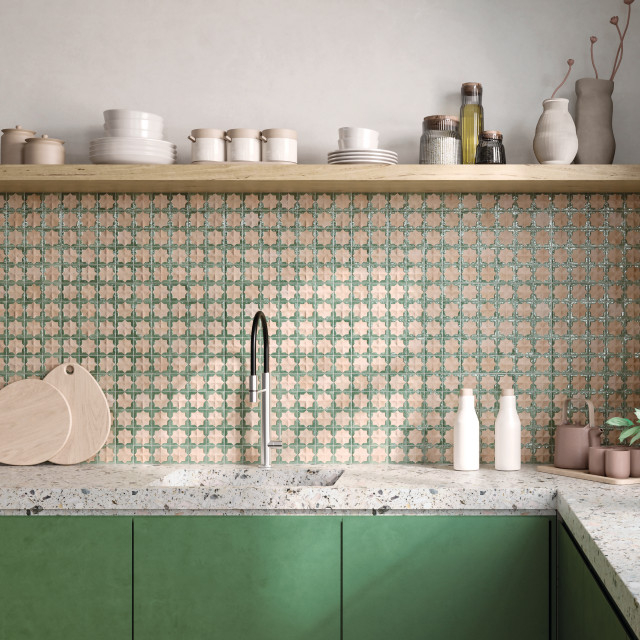
As someone who has spent decades with my hands in the clay, and my brow often furrowed in the intense heat of kilns, I can tell you there's a certain magic, a delicate dance, that happens when raw materials transform into something truly extraordinary. For emerald porcelain tiles, this transformation isn't just about color or form; it's about an alchemy that forges enduring strength and brilliant aesthetics. We're going to pull back the curtain on the firing process, the often-overlooked hero behind those stunning, resilient surfaces.
You see an emerald porcelain tile, and your eye is immediately drawn to its rich, verdant hue, perhaps its subtle sheen, or the intricate patterns that adorn its surface. But what you might not immediately grasp is that the true essence of that tile – its ability to withstand the march of time, the scuffs of daily life, and the relentless pull of gravity – lies not just in the ingredients, nor even in the skilled hands that form it. It resides, profoundly, in the kiln. The firing process, often perceived as a mere final step, is in fact the crucible where durability is forged, where the very molecular structure of the tile is irrevocably altered to create a product that can endure for generations. Without precise control here, all other efforts are, frankly, for naught. It's the moment of truth, the ultimate test.
The Pre-Firing Preamble: Setting the Stage for Success
Before any tile even thinks about entering the fiery maw of the kiln, there's a critical preparatory phase that's often underestimated. We're talking about drying. And not just any drying, but a meticulously controlled process. Think of it like a chef preparing a delicate soufflé; you wouldn't just throw it into the oven. The moisture content in green (unfired) tiles must be reduced slowly and evenly to prevent warping, cracking, or even explosive spalling during firing. Too fast, and you get internal stresses that manifest as invisible flaws, only to appear later during the high-temperature phase. We're often looking for a moisture content of less than 1% before the tile even touches the kiln's preheating zone. This 'bone dry' state ensures a smooth transition and reduces thermal shock, which is a big deal when you're talking about taking something from room temperature to over 1200 degrees Celsius.
The Kiln's Embrace: Understanding Temperature Zones and Their Purpose
Modern kilns, especially for porcelain, are marvels of engineering, typically continuous roller hearth kilns. They're not just big ovens; they're segmented masterpieces, each zone serving a distinct and vital function.
- Preheating Zone: This is where the last vestiges of physical water are driven off, and organic binders begin to pyrolyze (burn out). The temperature rises gradually here, preventing thermal shock and preparing the tile for the intense heat to come. It’s a gentle warm-up, if you will, crucial for structural integrity.
- Firing Zone (Sintering Zone): Ah, the heart of the beast! This is where the magic truly happens. Temperatures here can soar to 1200-1250°C (around 2200-2280°F) for porcelain. At these extreme temperatures, the feldspathic minerals in the body begin to melt and form a glassy phase that fills the pores between the solid particles. This process, known as sintering, is what gives porcelain its characteristic density, low porosity, and exceptional hardness. The duration at peak temperature, often called 'soak time,' is just as important as the temperature itself. Too short, and you don't get full vitrification; too long, and you risk deformation or over-vitrification, which can make the tile brittle.
- Cooling Zone: Just as important as heating, managed cooling prevents thermal shock and allows the newly formed crystalline and glassy phases to solidify and stabilize. A rapid, uncontrolled cool-down can induce stresses, leading to micro-cracks that compromise durability. Sometimes, there are even 'fast cooling' zones and 'slow cooling' zones to precisely control the crystal growth and final properties of the tile.
The Role of Atmosphere: Oxidation, Reduction, and Emerald Hues
Beyond just temperature, the atmosphere within the kiln plays a pivotal role, particularly when we're talking about specific colors like emerald. Most porcelain firing is done under an oxidizing atmosphere, meaning there's plenty of oxygen present. This ensures any carbonaceous materials burn out completely and iron impurities remain in their oxidized state, which generally leads to lighter, cleaner body colors.
However, for certain vibrant greens, and to achieve that deep, stable emerald, sometimes a very subtle, controlled introduction of reducing conditions (lack of oxygen) or specific mineral additions is explored. While direct reduction isn't typical for the body of porcelain due to potential bloating, the pigments themselves are highly sensitive. Cobalt, chromium, and copper compounds are often used to create green hues, and their final color can be profoundly influenced by the kiln atmosphere. For a stable emerald, we're usually ensuring precise oxygen levels so the chromophores (color-bearing ions) achieve their desired valency state, giving us that rich, consistent green without unwanted brown or grey undertones.
Common Firing Flaws and How to Sidestep Them
Even with the best intentions, things can go awry. Knowing the pitfalls is half the battle:
- Warping/Deformation: Usually a result of uneven drying, too rapid heating, or inconsistent kiln temperatures. This is where precise temperature profiling across the kiln's width and length becomes paramount. Think of it like baking a cake; if one side of the oven is hotter, that side will cook differently.
- Cracking: Often due to thermal shock during heating or cooling, or internal stresses from inadequate drying. We employ multi-stage drying and carefully ramped heating/cooling curves to mitigate this.
- Pinholes/Blisters: These can be caused by gases escaping too late in the firing process (e.g., from organic impurities or carbonates) when the surface has already vitrified. Ensuring thorough burnout in the preheating zone and precise control over the peak temperature and soak time is key. Sometimes, the raw material composition itself needs adjustment.
- Color Inconsistencies: Primarily a pigment issue, but also heavily influenced by firing temperature and atmosphere. Slight variations in peak temperature or oxygen levels can drastically shift an emerald from vibrant to dull, or even introduce unwanted shades. Strict quality control over raw materials and kiln conditions is non-negotiable here.
- Insufficient Vitrification: The tile comes out too porous, weak, and absorbs too much water. This is a tell-tale sign of insufficient peak temperature or soak time. The tile simply hasn't reached its full potential for densification.
Quality Control: The Unsung Hero of Firing Excellence
It's not enough to just set the kiln and walk away. Continuous monitoring and rigorous quality control are absolutely vital. We're talking about real-time temperature tracking within the kiln, often with dozens of thermocouples providing data. Post-firing, every batch undergoes a battery of tests:
- Water Absorption: This is perhaps the most critical test for porcelain. For a true porcelain, water absorption should be less than 0.5% (often much lower for high-quality emerald porcelain tiles). This directly reflects the degree of vitrification.
- Breaking Strength and Modulus of Rupture: These tests measure the tile's resistance to breaking under pressure, indicating its overall strength and durability.
- Mohs Hardness: While often related to the glaze, the body's hardness also contributes. Porcelain bodies are inherently very hard.
- Dimensional Stability and Flatness: Checking for warpage and consistent sizing. This is crucial for easy installation and a seamless final look.
- Color Consistency: Visual inspection and often spectrophotometric analysis to ensure the emerald hue is uniform across the batch and matches established standards.
These checks aren't just bureaucratic hurdles; they're the feedback loop that allows us to fine-tune the firing process, making minute adjustments to achieve that consistent, robust, and beautiful emerald tile every single time.
The Future of Firing: Smarter Kilns and Sustainable Practices
The world of tile manufacturing is always evolving. While the fundamental principles of firing remain, the technology is advancing rapidly. We're seeing more sophisticated kiln controls, integrating AI and machine learning to predict and prevent firing defects before they even occur. This means even tighter tolerances, less waste, and greater consistency.
Furthermore, there's a strong push for sustainability. Kilns are energy-intensive, so innovations in heat recovery, more efficient burners, and even exploring alternative energy sources are paramount. The goal isn't just to make a durable tile, but to do so with a smaller environmental footprint. It's an exciting time, where the ancient craft of ceramics meets cutting-edge technology, all in the pursuit of that perfect, enduring emerald porcelain.
Ultimately, the journey of an emerald porcelain tile from raw earth to a durable, dazzling surface is a testament to precision, patience, and a profound understanding of material science. The firing process isn't merely a step; it is the very heart of its creation, imbuing it with the strength to withstand the test of time. For those of us who live and breathe ceramics, it's a constant quest for perfection, a fiery dance that culminates in a product that is not just beautiful, but truly built to last. Understanding this process, even at a high level, gives you a deeper appreciation for the craftsmanship and engineering behind every single, magnificent emerald porcelain tile you encounter. It's a journey from fragile clay to an almost indestructible stone, all orchestrated by the controlled fury of the kiln.